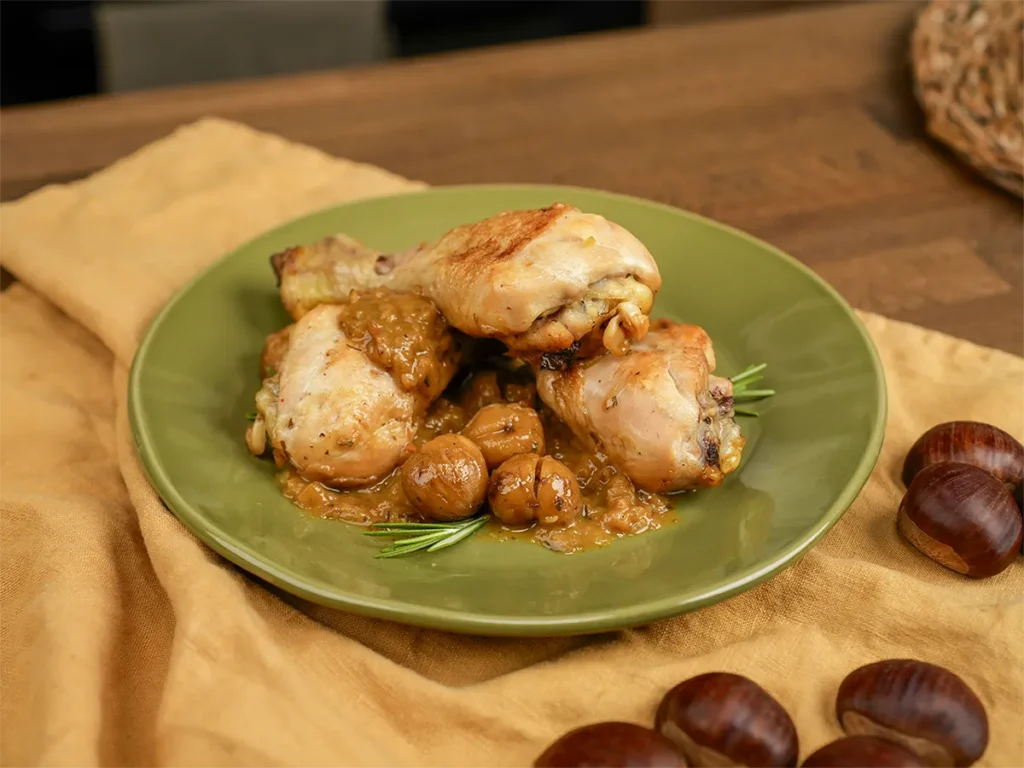
Lo spezzatino di pollo con olive e rosmarino è un secondo piatto che scalda la tavola, capace di trasformare pochi ingredienti semplici in un’esplosione di sapori mediterranei. In questa versione, gli chef Fileni hanno scelto di impreziosire la delicatezza dello Spezzatino di Pollo Bio con le olive Belle della Daunia D.O.P., note per la loro polpa consistente e il sapore sapido e avvolgente.
Per realizzare la pietanza, procurarsi i seguenti ingredienti:
400 g di Spezzatino di Pollo Fileni Bio;
100 g di olive Belle Della Daunia D.O.P.;
2 dl di vino bianco secco;
2 spicchi d’aglio;
1 peperoncino piccante;
3 semi di cardamomo (facoltativi);
3 cucchiai di olio extravergine d’oliva;
qualche rametto di rosmarino fresco;
qualche ciuffo di prezzemolo fresco;
sale fino q.b.;
pepe nero macinato fresco q.b. ;
Seguire questi passaggi per ottenere una carne dorata all’esterno e morbidissima al cuore.
In un tegame capiente, fare scaldare l’olio extravergine d’oliva con gli spicchi di aglio leggermente schiacciati. Unire il peperoncino intero, il rosmarino e la metà del prezzemolo precedentemente tritati in modo grossolano.
Aggiungere lo spezzatino di pollo Fileni, regolare di sale e pepe e far dorare la carne a fiamma vivace su tutti i lati per sigillare i succhi all’interno.
Aggiungere i semi di cardamomo leggermente schiacciati. Bagnare con il vino bianco e lasciar evaporare la parte alcolica. Proseguire la cottura a fuoco moderato per circa 20-25 minuti, aggiungendo – se necessario – un po’ d’acqua calda.
Cinque minuti prima di spegnere il fuoco, unire le olive Belle della Daunia. Rimuovere l’aglio e il peperoncino. Servire lo spezzatino ben caldo, cospargendo con il prezzemolo fresco rimasto.
L’aggiunta delle olive pugliesi eleva questa ricetta rurale a un livello gourmet. Originarie del foggiano, queste olive giganti vantano una storia millenaria che risale addirittura al XV secolo. Unirle allo spezzatino di pollo non è solo una scelta di gusto, ma un omaggio alla biodiversità del territorio italiano, creando un ponte tra la semplicità della carne bianca e la nobiltà delle certificazioni d’origine protetta.
Consulta i documenti utili.
Commissione Europea. (2012). Regolamento (UE) n. 432/2012 della Commissione del 16 maggio 2012 relativo alla compilazione di un elenco di indicazioni sulla salute consentite sui prodotti alimentari, diverse da quelle facenti riferimento alla riduzione dei rischi di malattia e allo sviluppo e alla salute dei bambini. Gazzetta ufficiale dell’Unione europea, L 136. Recuperato da https://eur-lex.europa.eu
CREA. Tabelle di composizione degli alimenti, Aggiornamento 2019- Website a cura di L. Marletta e E. Camilli (AlimentiNUTrizione – Tabelle Composizione Alimenti)
CREA – Centro di ricerca Alimenti e Nutrizione. (2018). Linee guida per una sana alimentazione (Revisione 2018).
The average fat content is calculated based on the sum of products representing 70% of the market value sales of breaded snack products (Source: Nielsen, AT October 2024; Scope: Hypermarkets + Supermarkets + Self-service stores). The reference value for the market average was obtained by considering all products belonging to the breaded snacks market, which account for 70% of the total and include the following brands:
The average fat content is calculated based on the sum of products representing 70% of the market value sales of spinach cutlets (Source: Nielsen, AT October 2024; Scope: Hypermarkets + Supermarkets + Self-service stores). The reference value for the market average was obtained by considering all products belonging to the spinach cutlets market, which account for 70% of the total and include the following brands:
50% less fat compared to the average of the classic breaded cutlets market. The average fat content is calculated based on the sum of products representing 70% of the market value sales of classic breaded cutlets (Source: Nielsen, AT October 2024; Scope: Hypermarkets + Supermarkets + Self-service stores). The reference value for the market average was obtained by considering all products belonging to the classic breaded cutlets market, which account for 70% of the total and include the following brands:
Fileni’s facilities, located in Cingoli and Castelplanio, in the Marche region, are certified to IFS, UNI EN ISO 9001, and UNI EN ISO 14001 standards and are dedicated to product processing.
Facilities and machinery undergo inspections and sanitization procedures according to predefined schedules, aimed at ensuring their proper functioning.
Organic supply chain processing operations are planned according to dedicated procedures and specific organizational measures designed to maintain the separation of production processes and reduce the risk of contamination.
Our organic products undergo checks at various stages of the supply chain. We also carry out inspections of the land and raw materials, in accordance with the requirements established by organic production protocols and regulations.
Our organic farms are located in rural settings characterized by green areas and outdoor spaces dedicated to the animals, as required by organic farming standards.
The facilities are equipped with technological systems designed to manage farming operations, and many sites have photovoltaic systems that help generate part of the electricity needed to operate the facilities.
Wheat, corn, soybeans, field beans, and protein peas are among the raw materials used to produce organic feed at our feed mill in Jesi. Legumes and cereals grown according to organic farming methods form the basis of the diet of chickens and turkeys in our organic supply chain.
Our commitment also extends to agricultural practices. For this reason, we are participating, on an experimental basis and as co-founders, in the ARCA project (Agricoltura per la Rigenerazione Controllata dell’Ambiente – Agriculture for the Controlled Regeneration of the Environment), established to develop and evaluate regenerative farming practices aimed at improving soil quality and the long-term resilience of agricultural land. Further information about the project, its objectives, activities, and adopted methodologies is subject to ongoing monitoring and updates and is available on the website https://www.arca.bio/.
Every journey begins here. In our hatcheries, we oversee the early stages of egg development, maintaining controlled temperature and humidity conditions throughout the incubation and hatching process.
Every journey starts with a solid foundation. That is why we pay particular attention to the reproduction stages, creating controlled environmental conditions suited to the animals’ needs. Daily care and attention throughout every stage of the journey, right from the very beginning.
I nostri bovini e suini nascono e vengono allevati biologicamente in Italia. Crescono liberi, seguendo il loro bioritmo naturale e un’alimentazione biologica con mangimi selezionati e formulati per offrire loro una dieta bilanciata, libera da OGM e sostanze chimiche non ammesse.
Ogni azione virtuosa ritorna. È il principio alla base della nostra visione circolare dell’intera filiera.
È per questo che partecipiamo al progetto ARCA (Agricoltura per la Rigenerazione Controllata dell’Ambiente), ideato da Bruno Garbini con Giovanni Fileni ed Enrico Loccioni, che si preoccupa di mettere in atto tecniche di agricoltura rigenerativa che consentono di preservare il terreno coltivato, mantenendone la fertilità e proteggendolo dal dissesto idrogeologico.
Operiamo ogni giorno per costruire filiere di eccellenza, diffondere buone pratiche sulla concimazione organica, la conservazione della biodiversità e per garantire al consumatore un prodotto sano e sostenibile.
The facilities dedicated to poultry product processing, located in Cingoli and Castelplanio (in the Marche region) operate according to systems certified to IFS, UNI EN ISO 9001:2015, and UNI EN ISO 14001:2015 standards.
Operations are subject to scheduled inspections carried out according to established procedures and in compliance with applicable requirements. Equipment and machinery undergo a regular cleaning and sanitization to help ensure the proper functioning of the facilities.
Products from our conventional poultry supply chain do not leave the company without passing quality checks, which we systematically carry out at every stage: from the land to the finished product.
Once laid, the eggs are kept in an incubator for 21 days, including 3 days in the hatching chamber. During this phase, maintaining the right balance between hygiene, temperature, and humidity is essential to ensure proper embryo development.
Fileni’s conventional poultry farms are mainly located in Central Italy, particularly in the Marche, Veneto, Emilia-Romagna, and Puglia regions. Here, chickens are raised on the floor in facilities equipped with technological systems for environmental management.
We pay particular attention to animal nutrition, ensuring that they follow a balanced diet consisting of cereals, legumes, minerals, and other nutrients. Expert animal nutritionists determine the types and proportions of the raw materials used.
We produce animal feed directly in our own feed mills, constantly monitoring its quality.
We raise animals according to protocols that take into account the behavioural needs of each species, paying particular attention to environmental conditions, which are constantly monitored.
Stay up to date with the latest news from Fileni.